Rubber Paving
Rubber Paving in Canada: Uses, Preparation and Limits
Learn where poured rubber surfacing can fit, what must be assessed before installation and why the condition beneath the finish matters.
Équipe Aménagement Lalonde · · 9 min read
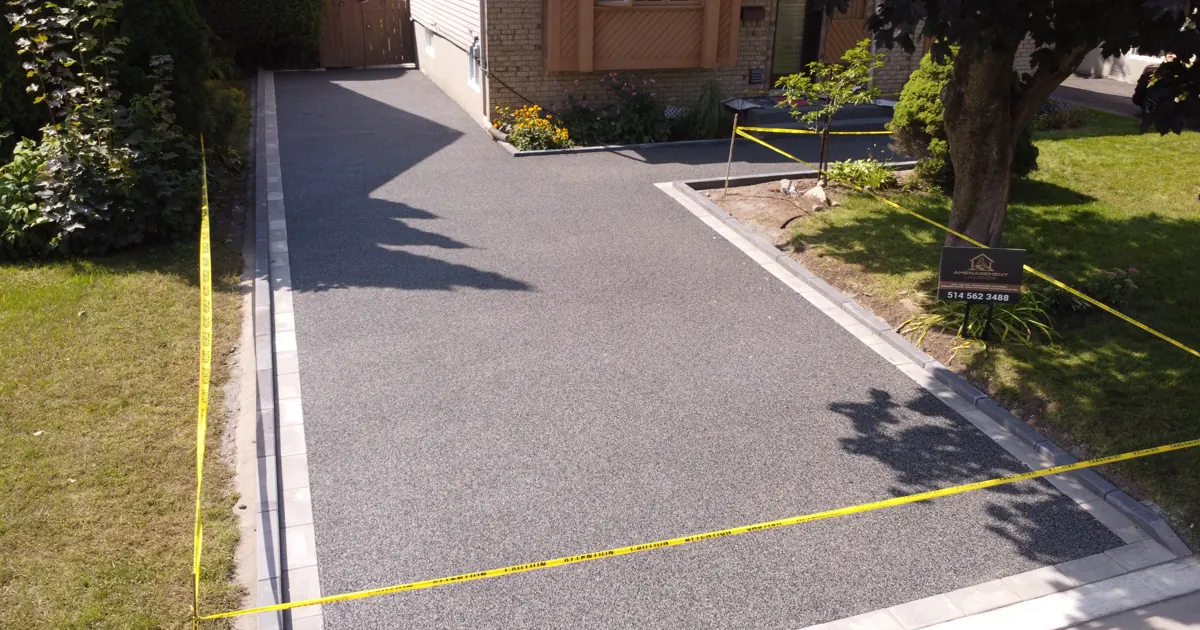
Rubber paving is a poured surfacing system that can renew selected outdoor areas without automatically rebuilding the entire landscape. In a Canadian climate, however, the outcome depends on the substrate, slopes, drainage, system design, installation conditions and ongoing maintenance.
The term can also be misleading. A decorative polyurethane-bound rubber surface used at a home is not the same material as rubberized asphalt used on roads. Residential work generally involves a designed layer or layered system installed over a base that has been assessed and prepared for its actual use.
Where rubber paving can make sense
Common applications include pool surrounds, patios, pedestrian paths, selected balconies and some driveways. The material can follow curves, bridge planned transitions and use blended colours, which makes it useful when circulation and landscape design need to work together.
Those applications are not interchangeable. A walkway, a wet pool area and a vehicle surface place different demands on the base, thickness and drainage plan. A suitable design starts with how the area will be used, not with a finish selected from a photograph.
- Walkways where existing or corrected slopes can shed water
- Patios and terraces supported by a stable, drained base
- Pool decks coordinated with coping, access controls and equipment
- Driveways only after vehicle loads and turning areas are assessed
The substrate carries the system
Rubber does not repair a moving slab, severely rutted asphalt or a base that traps water. Before recommending an overlay, the installer should identify active cracks, settlement, crumbling edges, contamination and transitions around drains, doors and steps.
Some substrates can be repaired and prepared. Others need localized or full reconstruction before a finish is sensible. That decision changes the system and the scope of work, which is why area alone is not enough for a reliable quotation.
- Assess stability and potential bond conditions
- Map cracks, movement and previous patches
- Check finished heights at thresholds, steps and pool coping
- Confirm that surface water has a workable outlet
Drainage, slopes and exposed edges
An outdoor surface should move water to an appropriate destination instead of toward the building, a neighbouring property or a closed low point. Existing grades need to be measured before resurfacing because a new finish placed over poor geometry can preserve the same ponding problem.
Edges are equally important. An unsupported termination, abrupt height change or exposed lip can be affected by traffic, maintenance tools and freeze-thaw cycling. Edge details should be selected for the base, circulation pattern and adjacent materials.
- Locate downspouts, drains, catch basins and runoff paths
- Do not block an existing drainage route
- Protect terminations from impact and concentrated loads
- Coordinate finished elevations with doors and landscaping
Understanding EPDM, SBR and layered systems
Coloured EPDM is commonly considered for a finish layer, while recycled SBR may be used in a base layer or other system configuration. Granule size, binder, thickness and mixing method work together; comparing only the material name leaves out most of the design.
Sun exposure, function, desired texture and substrate conditions all influence the specification. A contractor should be able to explain the proposed layers, preparation, transitions and application conditions without claiming that one product will solve every site defect.
- Request a written description of the complete system
- Clarify which repairs and preparation are included
- Select texture with both use and cleaning in mind
- Verify compatibility with the substrate and previous coatings
What rubber paving does not replace
The finish is not a substitute for compacted support, functional drainage or a structure designed for the expected loads. It should not be used to hide a failure that water, frost or traffic will continue to worsen below the surface.
Comfort and texture should not be presented as a blanket safety guarantee. Surface conditions change with water, ice, contamination and wear. Accessible, municipal and playground projects may require specific criteria and testing beyond a typical residential installation.
- No outdoor material eliminates ice or routine maintenance
- A coating does not automatically stabilize a moving base
- A seamless finish does not replace access controls or applicable rules
- Performance must be evaluated for the site and intended use
Preparing for a useful site assessment
Collect dimensions, overview and detail photos, the approximate age of the base and notes about what happens after rain or spring thaw. Describe the intended traffic, vehicles, equipment, snow-clearing method and any future landscaping work.
A site visit can then confirm grades, weak areas and edge conditions. Cost is shaped by area, access, preparation, repairs, drainage, system build-up, colour blend and detailing. A useful proposal separates those elements instead of offering an unsupported square-foot figure.
- Document ponding and seasonal movement
- Identify loads, traffic patterns and restricted access
- Ask what is excluded as well as included
- Plan a maintenance method compatible with the proposed system
Frequently asked questions
Can rubber paving be installed over concrete or asphalt?
Sometimes, if the surface is stable, clean, properly prepared and adequately drained. Active cracks, settlement, deteriorated edges or trapped water may require repair or make a straightforward overlay unsuitable.
Is rubber paving appropriate for a driveway?
It can suit some systems designed for vehicle traffic, but the base, loads, wheel turning, drainage and winter maintenance must be assessed. A patio specification should not automatically be used on a driveway.
Will the surface be slippery in winter?
Any exterior surface can become slippery when wet, snow-packed or icy. Texture, drainage, grading and appropriate maintenance affect conditions; no finish can guarantee traction in every weather event.
What affects the cost of rubber paving?
Area, access, substrate condition, repairs, drainage, thickness, colour blend, edges and geometry all affect the scope. An inspection is the responsible way to price a site-specific system without inventing a generic range.